



This is the first year the Tuesday Targets are scored in public. We are still testing which exit rule fits each kind of trade and each level of risk, so the wins, the losses and the percentage above can change a little after the fact when a back-test finds a better rule. That happened today: we found that taking profits earlier suits every kind of trade, and all 2026 targets are now scored that way. Last week this line read 20 won, 20 lost, +32%. Once the rules are settled, they stay.

What Is an Iron Condor. An iron condor is four options in one order: you sell a put and a call near the price and buy one of each further out as insurance. You keep the credit if the stock stays between the short strikes, and the insurance fixes the worst case in advance.
Enter all four legs as one order at the mid, net credit, day order. A few cents less credit is fine to get filled.
The Setup
Uber is stuck between two stories. The business: on November 4 it reported gross bookings of 59.8 billion dollars for the third quarter, up 20 percent, the fifth quarter in a row above 20, with profit per share up 35 percent. The fear: robotaxis. Tesla began selling its Cybercab on November 13, and Waymo plans to take its cars off the Uber app in Austin and Atlanta in 2028. The stock is down 14 percent this year and 24 percent under last December's high.
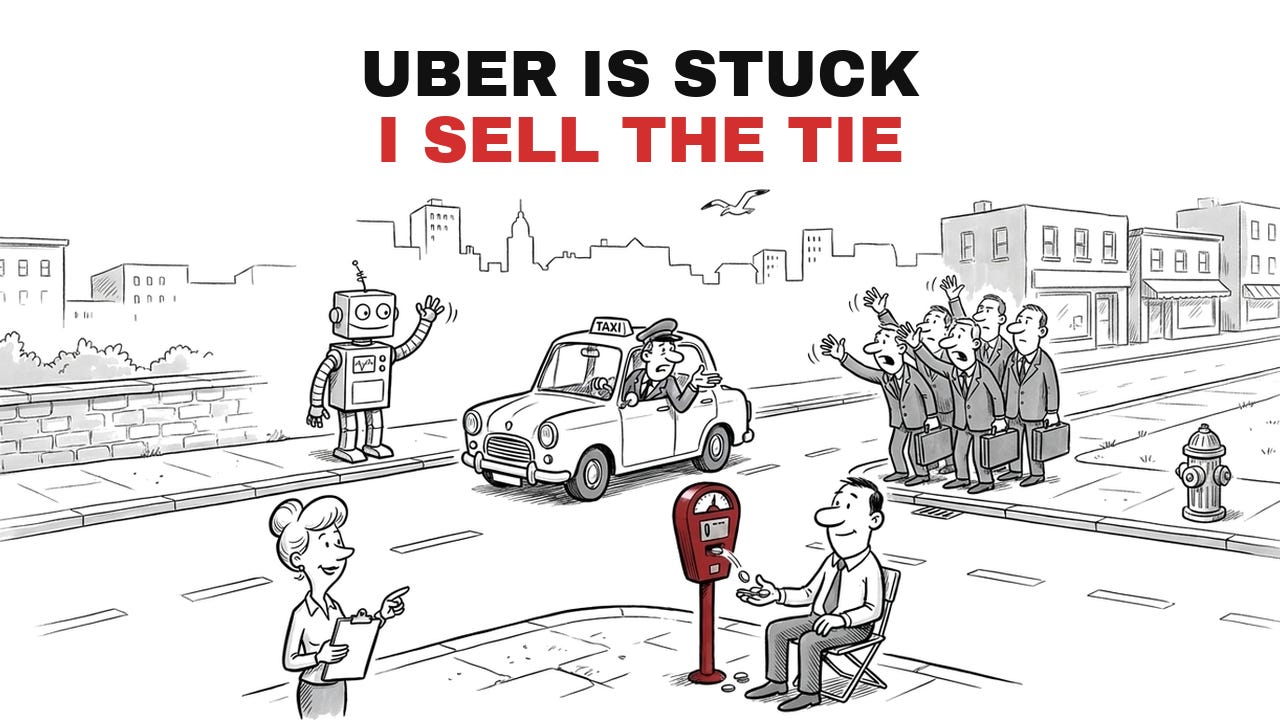
Neither story has won. Since the report Uber has traded between 67 and 72.50 and closed Monday in the middle. That standoff is what I sell: an iron condor into December, four options that pay me up front for fencing a range around today's price. It is neutral. It wins if Uber stays where it has been since its report, with similar room on both sides.
Where You Win, Where You Lose
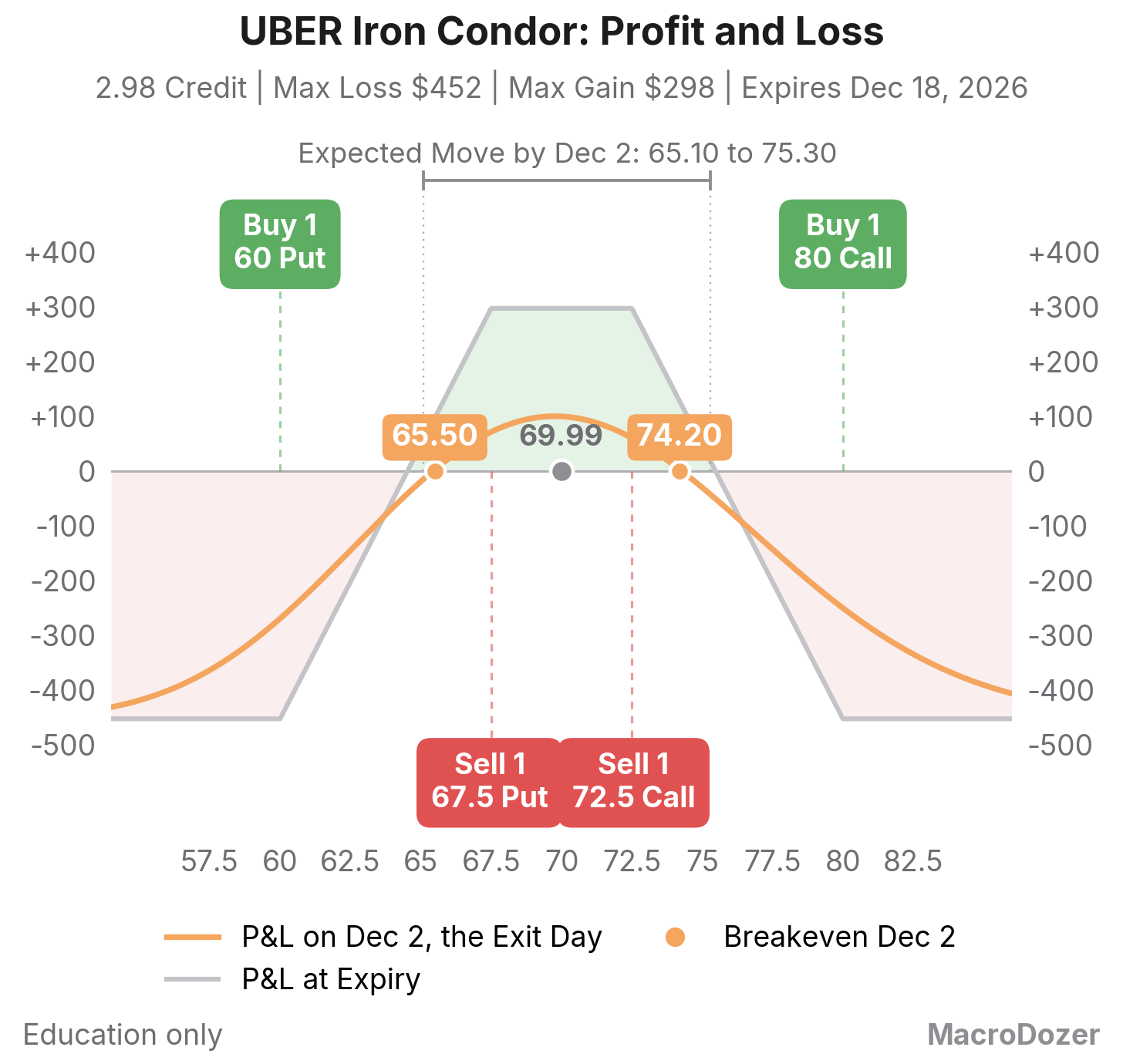
UBER iron condor, 2.98 credit: the grey line is the profit or loss at expiry, the orange curve on Dec 2, the exit day, with breakevens at 65.50 and 74.20. Max loss $452, max gain $298 per contract.
What you are betting. You are betting that Uber stays between the two break-evens until December 2, about 7 percent below Monday's close to 6 percent above, similar room on both sides. The plan takes the profit at a quarter of the credit, about 16 percent on the money at risk.
When we are wrong, and what we do then. The story breaks if the standoff ends: a robotaxi headline or a tech sell-off that carries Uber below the lower break-even, 7 percent down, or above the upper one, 6 percent up, before December 2. Two thirds of the stake lost is where I stop. The exit rule: the profit is taken when a quarter of the credit is earned; else out by Dec 2, 16 days before expiry, not later. Earlier when the loss reaches two thirds of the max loss, or when the reason for the trade breaks.
The Chart
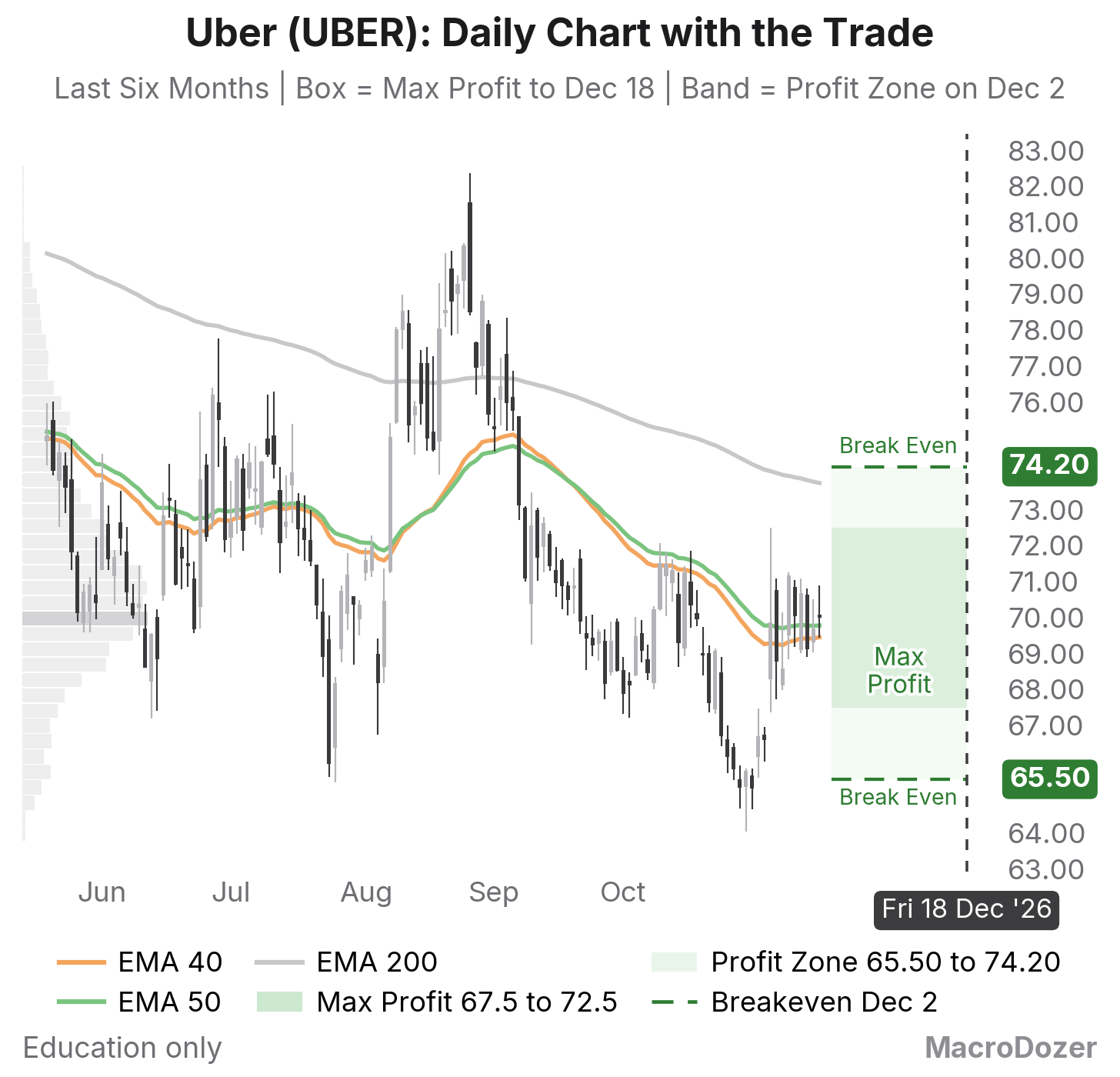
Uber (UBER), daily candles over six months with the 40, 50 and 200 day averages. The box is where the whole credit is kept, the band between 65.50 and 74.20 is the profit zone on Dec 2.
Trend: down 14 percent this year and 24 percent under last December's high, flat since the November 4 report, sitting on its 40 and 50 day averages and under its 200 day average (EMA40, EMA50 and EMA200 as drawn).
Levels: the lower break-even sits above the October 30 low close of 65.25; the upper one sits above the report-day high of 72.50 and the 200 day average near 74.
The Big Picture
The fence follows the chart. The lower break-even sits above the low of late October, the year's low. The upper one sits above the report-day high and above the 200 day average. To lose, Uber has to break a level that has held.
Both camps have fresh ammunition. On Monday Amazon's Zoox put its robotaxis on the Uber app in Las Vegas, and Uber expects about 700 driverless cars on its app by year-end. The same day two Waymo cars crashed in Phoenix and three people went to hospital. And the market around it is nervous: Nvidia reports tonight, and Goldman's prime desk counts the fewest tech longs against shorts since its records began in 2016. A tie like this pays the one who fences it.
Three Things That Matter Before Dec 2
Nvidia reports tonight, the Fed's minutes come Wednesday, Anthropic lists Thursday. Uber swings about 1.3 times as hard as the market. A hard tech sell-off would test the lower break-even first; with Uber near it, I close early.
Uber is due at an investor conference on Wednesday, November 18. A robotaxi partner won or lost is the kind of headline that ends a standoff in one morning, and it can push the stock in either direction.
Over the past year Uber ended a stretch this long inside a box this size 71 percent of the time. The breaks leaned down: 42 went lower, 31 higher. The next report is in February, after the trade.
Sources: Uber, Nov 4. Tesla, Nov 13. TechCrunch, Nov 16. ABC15 Arizona, Nov 16. Goldman, Nov 15. Prices: mid quotes at the close, Nov 16.
The Open Book

The older Tuesday Targets still running, marked at the close of Nov 16, as the scoreboard carries them. The letters: EWZ 44/52, FXI 46/52. Every one is scored in public, winners and losers alike.
📚 New on the site: the MacroDozer Reading List. Eleven options books by level, with a free buying guide for each and full summaries for paid members. Read the list.
Tuesday Target Live This Thursday
Tuesday Target Live is my free Thursday session: thirty minutes on Zoom, the Tuesday Target trade on screen. This Thursday, November 19, at 10:00 am New York time, 3:00 pm in London: where the UBER trade stands, what has changed since Tuesday, and your questions. It is free. One click on the link and you are in, no Zoom account needed.
New time from this week: half an hour earlier than before.
The Zoom link goes out by email on Thursday morning to everyone on the free Tuesday Target list. Not on it yet? One click below and it reaches you too.

Every Tuesday Target of the year, scored, winners and losers alike.
Every entry, repair and exit in my own account is posted the moment I make it: Trade Alerts, part of Pro.

Every Wednesday, Elite Traders watch me run a real portfolio live. A growing lesson library and ten one-on-one sessions with me come with it.

All articles are purely educational; they are not tailored to any particular individual or portfolio and do not constitute investment advice.