


🎯 TUESDAY TARGET: First Solar (FSLR) | 👇 Reveal the Play

Something strange happened last week: everyone in charge handed their job to someone else.
Start with the Fed. Kevin Warsh stared at the highest long-term yields since 2007 and declared victory by proxy, if the bond market prices in tightening, why bother hiking? Inflation-fighting, outsourced to bond investors whose entire profession is distrusting him. A central banker paying his enemies to do his homework.
Then Japan. The BOJ refuses to raise rates because higher yields would torch a bond market it already half owns. So the Ministry of Finance, now with Washington’s blessing and a record ~$88 billion in two days, bought the yen instead. Bessent’s handwritten to-do list (Buy Japanese Yen $5-10 bil) even made it into a Reuters photo. Monetary policy by sticky note. The real motive? Keeping Tokyo from dumping Treasuries to fund its own defense. The carry trade, borrow cheap yen, park it anywhere yielding more, is a multi-trillion tower, and nobody wants a live demolition test.
Finally, the week’s purest lesson in delegation: Situational Awareness, the $45 billion AI fund, discovered that leverage means your prime broker decides when you sell. Citadel took the book at a discount and reportedly cleared a billion-plus within a day.
Control has become a costume. The steering wheels are being quietly passed around.
Below, as always, all you need to know and not a word more:
Tokyo Buys Time by the Billion
Japan wants a stronger yen, yet the Bank of Japan refuses to raise rates, higher yields could crack a bond market it already half owns. So the finance ministry bought yen directly: roughly $53 billion Thursday, a single-day record, plus $33 billion Friday, with Washington joining for the first time since 2011. Identical campaigns have burned $255 billion since 2022. Goldman expects the next BOJ hike in January 2027.
The Carry Trade Checks Its Pulse
For years, traders have borrowed cheap yen and parked the proceeds in higher-yielding dollars — the carry trade, effectively a standing bet against the yen. That bet still pays over two percentage points. The intervention is now squeezing crowded yen bears; their forced exits could drag USDJPY toward Goldman’s 152–153. JPMorgan doubts any lasting break of 150, because once they’re flushed, the borrowing resumes.
Ceasefire by Social Post
Crude tumbled as much as seven percent after Washington shelved planned strikes and floated a Hormuz reopening by Tuesday. Tehran promptly denied direct talks, launched drones at tankers, and reportedly clipped a US base in Kuwait. Meanwhile the futures curve stays steeply backwardated, the market’s way of saying physical barrels remain scarce whatever the headlines celebrate. We’ve watched this exact episode before; reruns usually end with fresh explosions.
Pay Up for Proof
The verdict on AI capex arrived with brutal clarity. Microsoft added over half a trillion dollars in one session after Azure accelerated to 43% growth; Amazon jumped 15% despite lifting capex to $220 billion, because AWS margins expanded alongside a $25 billion AI run-rate. Meta, whose margins shrank from 43% to 31%, got spanked. Spending earns applause only once it visibly earns money.
The Volatility Split Screen
Study the divergences: yen volatility exploded while the VIX naps near 16, a pairing with no historical precedent. Treasury options carry put skew in the 98th percentile, bracing for higher yields, while QQQ downside protection trades near multi-year lows. Half the S&P’s sectors now move inversely to the index itself, something never recorded before. Index calm, single-stock chaos. That’s a dispersion trader’s paradise, and everyone else’s trap.
THE WEEK: Jobs Take the Wheel
Labor data dominates: JOLTS openings today, ADP Wednesday, then Friday’s July payrolls, where consensus expects 85k jobs and 4.2% unemployment, with risks of a tick higher. Wednesday’s ISM services and Thursday’s productivity fill the gaps, while Fed speakers Cook, Schmid, Musalem and Barkin audition their September votes. Earnings roll on with AMD, Caterpillar, Eli Lilly, Disney and SpaceX’s debut report. Warsh watches; the data decides.
Tactics for this Tape
Treat this bounce as a repositioning window rather than a green light. Upgrade quality, trim anything whose only thesis was price momentum, and keep cash ready for a retest. With half the index showing flat or inverted call skew, upside via call spreads beats chasing stock. Respect August seasonality, watch the 30-year, and let volatility sellers fund your patience. Survive first, compound second.
Don’t guess. Reach out. Let’s build a capital-efficient yet risk-managed strategy from the option chain up.
Get Rich Overnight with Options? Yeah Right...
TUESDAY TARGET: First Solar (FSLR)
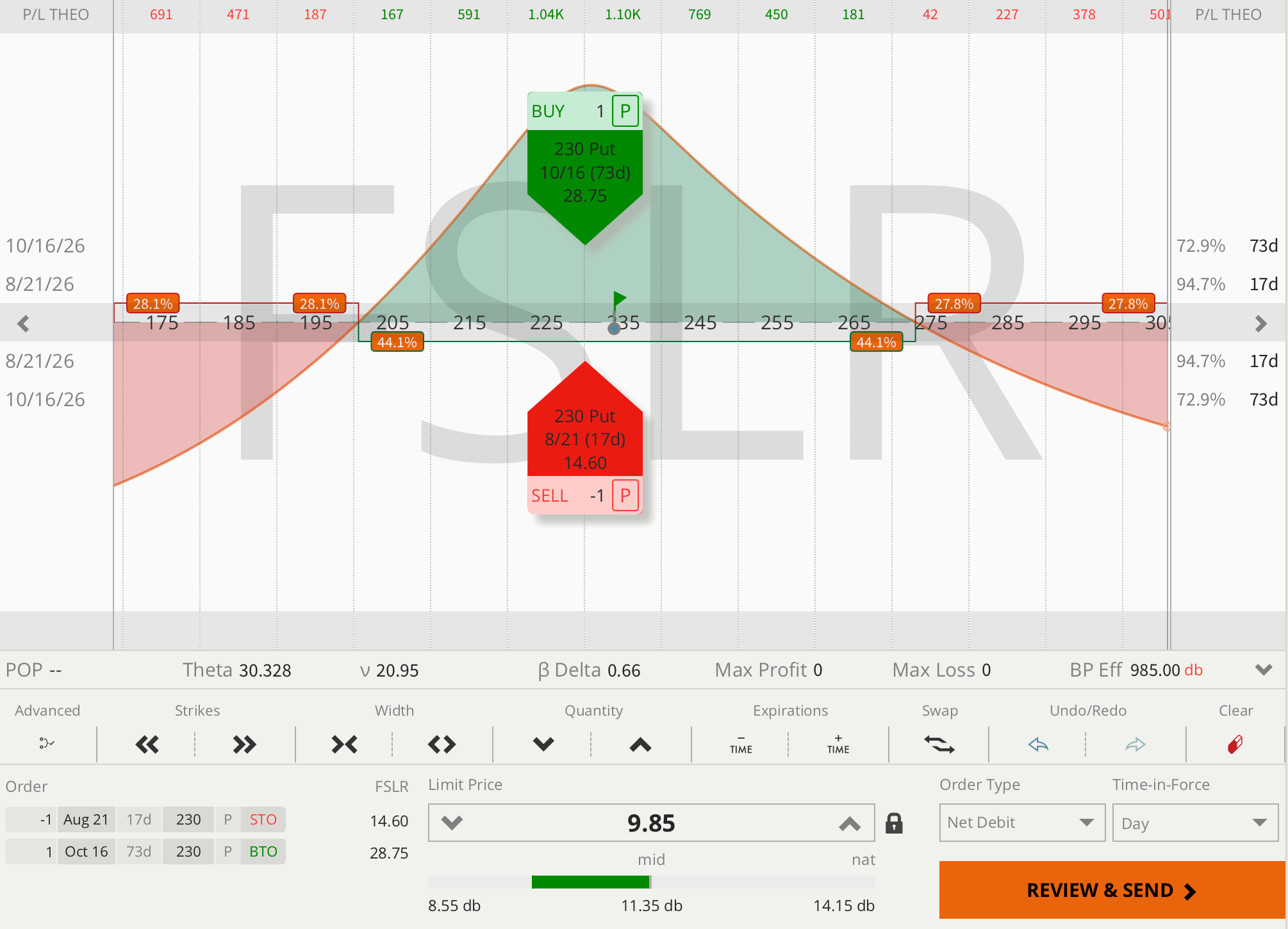
High-risk single put calendar. Adjust the strike if you feel a different directional push. This one comes from testing our Daily Doze lists. They are far from ready, but already good for inspiration. Non-stop work on improvements, hence the late Tuesday Target and no podcast or video show this week.
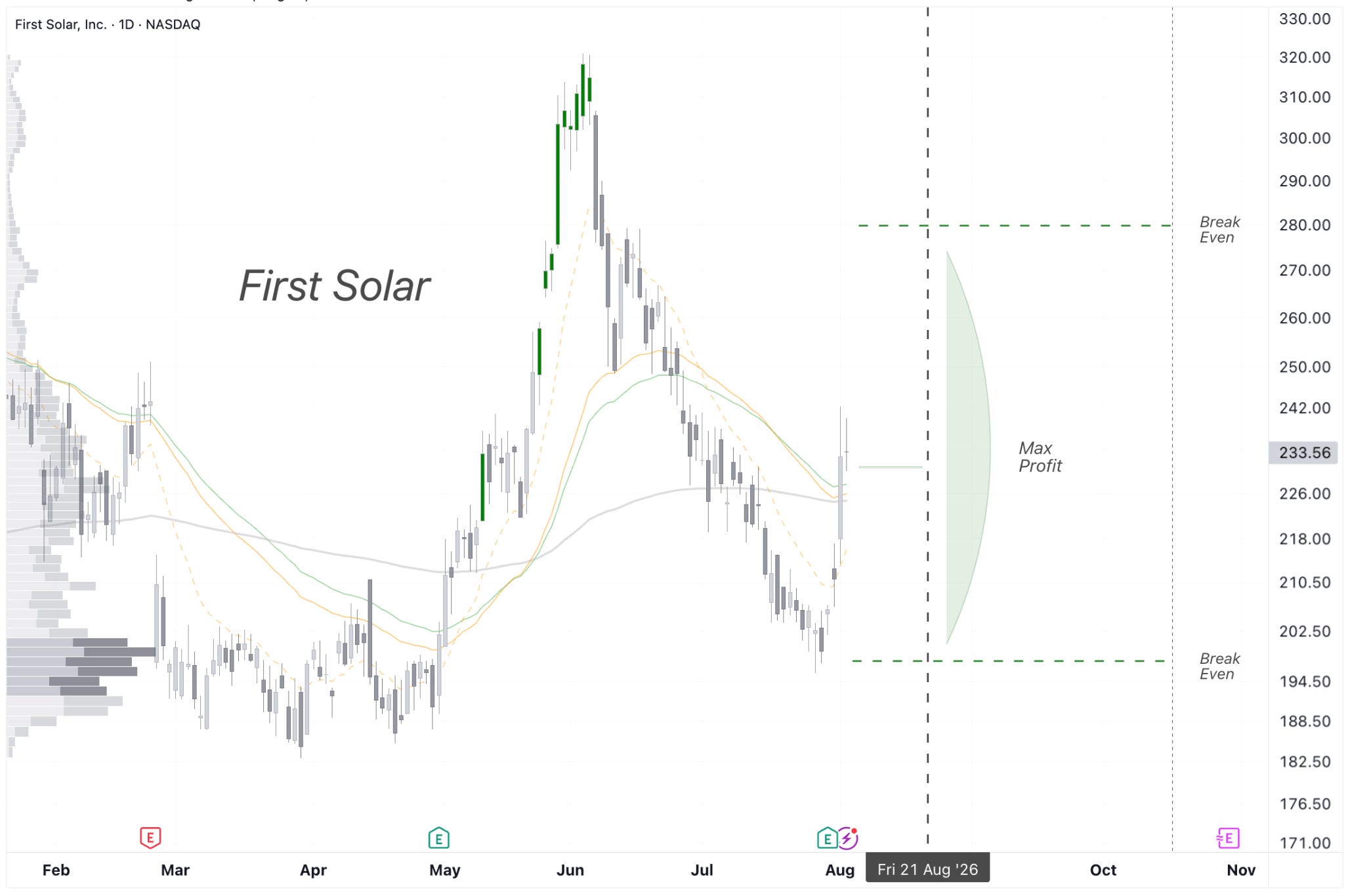
First Solar just round-tripped from 320 to 197 and back to 233, and the options market still prices panic. That is our harvest. We sell the front-month put and buy the same strike two months out, paying a debit. The trade wins if FSLR digests its move between the breakevens through August, collecting roughly $30 a day in theta while front-month vol deflates. The back leg keeps us positioned through the next rate and policy window. Risk stays capped at the debit. Close or roll around front expiry.
One caveat before entry: the fat August premium is no leftover from earnings, which passed on July 30. It reflects Washington. The pending Section 232 polysilicon tariff ruling could drop any day in August and decides the fate of First Solar’s idle Malaysia and Vietnam capacity. A hard ruling likely gaps the stock upward, past our upper breakeven. Size accordingly, or shift the strike higher.
This is not an official trade entry, just food for thought. Official trade entries are posted in the Trade Alerts section. Over there, we relentlessly innovate and deliver novel setups.
All our recent trades and the reasoning behind them can be found in the Trade Alerts section. Think of it as a behind-the-scenes look into our process, so you can decide if it’s worth adopting (or adapting) in your own strategy.

☕ NEW: The Daily Doze
A live read on the options market, refreshed through the trading day. Six boards and a shortlist:

⓵ Setup Radar decoding momentum (free)
⓶ Boiler Room hunting premium worth selling
⓷ Front-Loaded Scare flagging front-month fear
⓸ Overpriced Move auditing inflated expectations
⓹ Earnings Grenade defusing pre-print panic
⓺ Gamma Map charting where dealers pin and push
🏆 The Shortlist naming tonight's survivors
Every Tuesday Target trade walks straight off one of these boards; the Daily Doze pays for itself before your first sip.
Refill your cup → Daily Doze
🧠 Elite Trader Plan
And if you need a calm, step-by-step options plan that grows accounts and tames big swings, check out the Elite Trader Plan. In 4–8 sessions, we will bring you fully up to speed, all included in the plan.


📅 60-Minute Mentorship Call
More time = more value.
📌 Advanced Options
📌 Risk Management
📌 Capital Efficiency
Rate: $135 | 👉 Book 60-Minute Call
Elite Trader: $110 | 👉 Book Elite Trader Call
⏳ 30-Minute Session
Less time = more often.
📚 In-Depth Learning
🧠 Strategy Breakdowns
🔍 Trade Reviews
Rate: $95 | 👉 Book 30-Minute Call
Elite Trader: $55 | 👉 Book Elite Trader Call
Tuesday Target is written by Juri von Randow — founder of MacroDozer, professional investor, and trading mentor — delivering institutional-grade trade ideas, market insights, and strategy every week for serious1 investors.
🚨 Educational content only. Not financial advice. Past performance ≠ future results.
If you are only here for the money, look elsewhere. Success requires a dedication to the craft.