




What Is an Iron Condor. An iron condor is four options in one order: you sell a put and a call near the price and buy one of each further out as insurance. You keep the credit if the fund stays between the short strikes, and the insurance fixes the worst case in advance.
Enter all four legs as one order at the mid, net credit, day order. A few cents less credit is fine to get filled.
The Setup
October was the month the AI trade broke. The Nasdaq 100 lost 6.7 percent, its worst month against the equal-weight S&P since 2002 by Goldman's count, and the money went somewhere: the Dow, the index of old economy names, rose 1.7 percent, and consumer staples had their best month since 2000, BTIG notes. DIA, the Dow fund, closed on Monday 4 percent under its August record.
That calm is what I sell. The Dow has moved like a quiet fund lately, about 10 percent a year, while its December options price 16. So I sell an iron condor into December: four options that pay me up front for fencing a range around today's price. The fence is not centred. It leans bearish: it wins most if the Dow drifts a little lower or goes nowhere, with less room on the upside. That suits a reader who already owns plenty of stocks and wants one position that pays if the rotation rally pauses.
Where You Win, Where You Lose
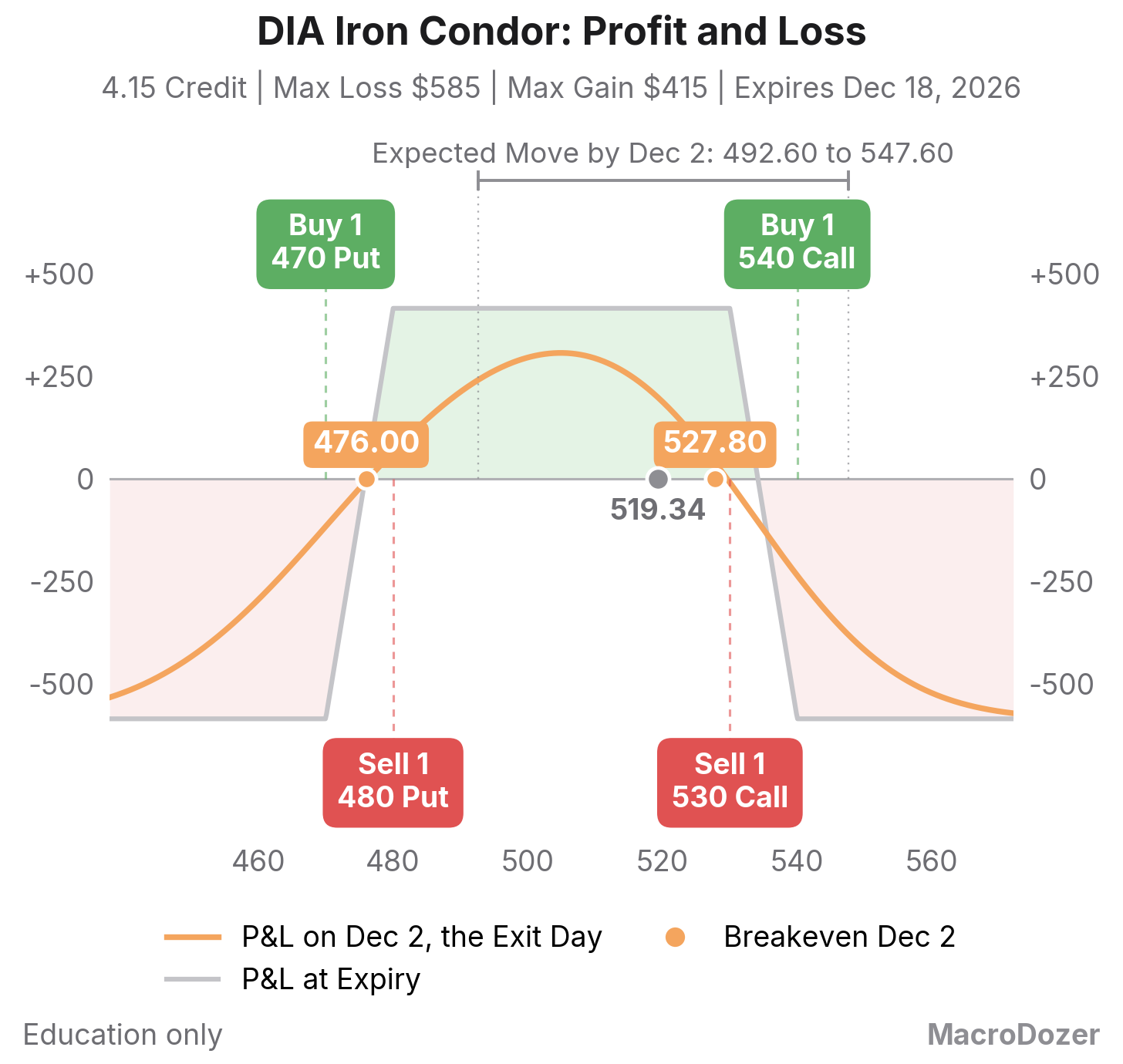
DIA iron condor, 4.15 credit: the grey line is the profit or loss at expiry, the orange curve on Dec 2, the exit day, with breakevens at 476.00 and 527.80. Max loss $585, max gain $415 per contract.
What you are betting. You are betting that DIA stays between the two break-evens until December 2, about 8 percent below Monday's close to 2 percent above, far more room down than up. Near today's price that pays about 50 percent on the money at risk.
When we are wrong, and what we do then. The story breaks if the range breaks: a post-election rally past the upper break-even, 2 percent up, or a shock below the lower one, 8 percent down, before December 2. The rally is the nearer danger. Half the stake lost is where I stop. The exit rule: out by December 2, two weeks before expiry; sitting in the middle of the range, I may hold longer. Earlier only if a fast move costs about half the stake and the story has changed.
The Chart
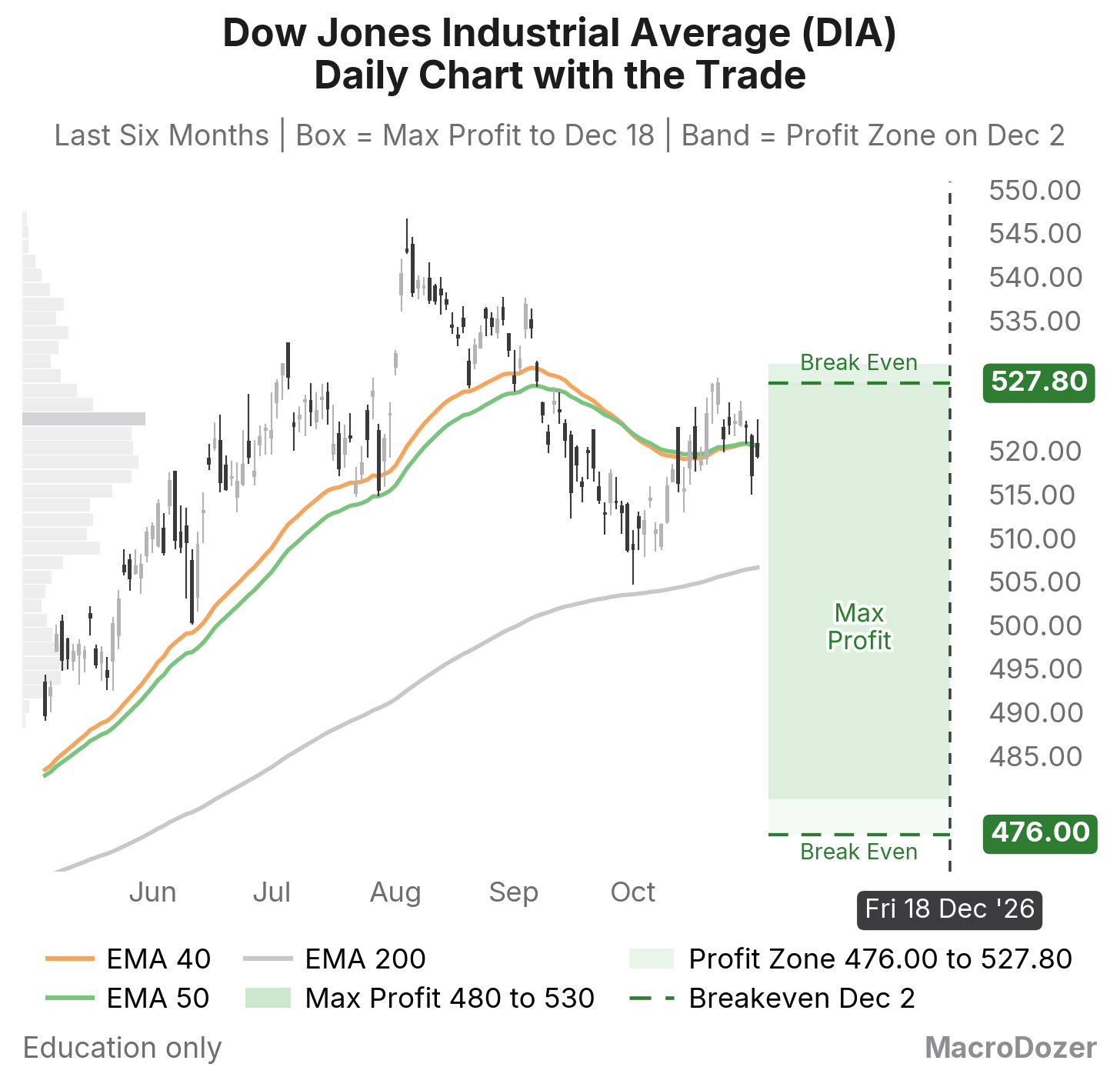
Dow Jones Industrial Average (DIA), daily candles over six months with the 40, 50 and 200 day averages. The box is where the whole credit is kept, the band between 476.00 and 527.80 is the profit zone on Dec 2.
Trend: up 7 percent this year and 4 percent under the record close of August 5, back above its 40 and 50 day averages since mid-October (EMA40 and EMA50 as drawn).
Levels: the lower break-even sits far under the September low and the put wall near 500; the upper one under the record high and the call wall near 540.
The Big Picture
The range is the market's own. The options price a move of about 5 percent either way by December 2; we fence the inside, the top rail close, the bottom rail far. One more thing favours a fence here: the way Dow options are positioned, the big dealers who hedge them lean against every move, which keeps the Dow quiet; in the Nasdaq their hedging adds to the moves.
The big houses disagree, which is what a range trade wants. Bank of America's Michael Hartnett stays risk-off until mid-November. Morgan Stanley's Mike Wilson sees one last washout before his 8,000 year-end target. UBS warns that November, the best month since 1950, meets near-record shorts, a squeeze. JPMorgan counts the S&P higher a year after every midterm since 1950. Each has placed a bet; we collect from all of them, leaning to Hartnett's side.
Three Things That Matter Before Dec 2
Four dates sit inside: the refunding on November 4, the jobs report on November 6, CPI on November 10 and Home Depot and Nvidia reporting on November 17. With DIA near a break-even into any of them, I close early.
The upside is the thin side. Over the past year a box like this held about half the time, and every break went up. The rotation rally has to pause for the top rail to hold; that is the bearish lean.
JPMorgan prices a Democratic sweep at 66 percent, the one result where its S&P map includes a loss, a quarter percent dip to a half percent gain. Every other outcome points higher: a split Congress by up to one percent, a Republican hold by more.
Sources: Goldman, Nov 2. BTIG, Nov 2. BofA, Nov 2. Morgan Stanley, Nov 1. UBS, Nov 2. JPMorgan, Nov 3. official calendars and WSH, Nov 2. Prices: mid quotes, Nov 3.
The Open Book

The older Tuesday Targets still running, marked at the close of Nov 2, as the scoreboard carries them. The letters: AMPL 36/52, TLT 41/52, SPY 43/52, EWZ 44/52. Every one is scored in public, winners and losers alike.
Tuesday Target Live This Thursday
Tuesday Target Live is my free Thursday session: thirty minutes on Zoom, the Tuesday Target trade on screen. This Thursday, November 5, at 10:30 am New York time, 3:30 pm in London: where the DIA trade stands, what has changed since Tuesday, and your questions. It is free. One click on the link and you are in, no Zoom account needed.
The Zoom link goes out by email on Thursday morning to everyone on the free Tuesday Target list. Not on it yet? One click below and it reaches you too.

Every Tuesday Target of the year, scored, winners and losers alike.
Every entry, repair and exit in my own account is posted the moment I make it: Trade Alerts, part of Pro.

Every Wednesday, Elite Traders watch me run a real portfolio live. A growing lesson library and ten one-on-one sessions with me come with it.

All articles are purely educational; they are not tailored to any particular individual or portfolio and do not constitute investment advice.